The Complete Soccer Uniform Buying Guide for Clubs
Buying soccer uniforms for a club is not like buying shirts off a rack. One order has to fit every player, survive a full season of matches and washing, and look like the same club from the under-8s to the senior side. Get it right and the kit is something you forget about for the rest of the season. Get it wrong and you spend the season apologising for it.
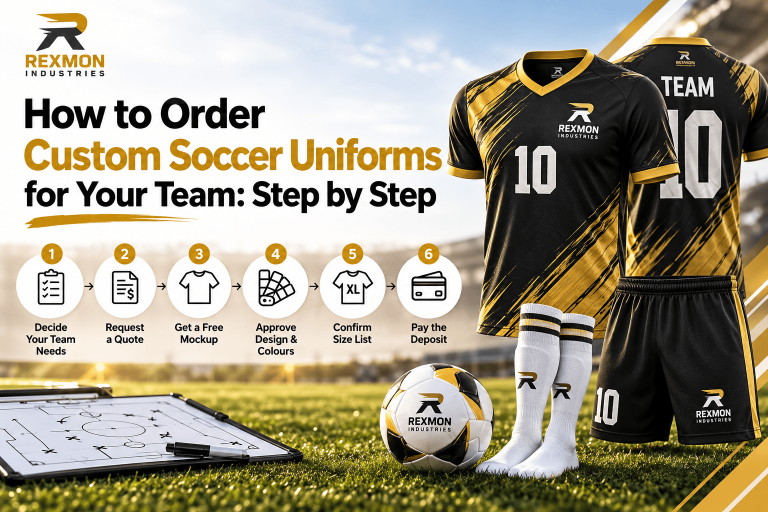
This guide covers the decisions a club actually has to make: how to choose a supplier, what a full kit is made of, how to think about fabric, how the design works, and what to check before you order. Three topics have their own guides, and this post does not repeat them. How to place the order step by step is in our guide to ordering custom soccer uniforms. What it costs and what changes the price is in our guide to how much custom soccer uniforms cost. How to collect sizes from your squad is in our soccer uniform sizing guide. Everything else is here.
Start With the Supplier, Not the Shirt
The single biggest decision in buying uniforms is not the colour or the fabric. It is who makes them. A good supplier makes every other decision easier; a bad one makes every other decision pointless.
A real manufacturer makes the kit in its own facility. That matters because it controls the fabric, the print, the stitching and the sizing, and because your order is priced directly, without a trading company or an agent in the middle. Ask whether the supplier owns its factory, and ask to see it. A manufacturer that owns its floor can show you photos or video of the production line and the machines. A reseller buying finished kit and selling it on cannot.
Capacity is the next thing to check. A factory that produces more than 50,000 pieces a month can take on a whole league order or a multi-team academy without pushing a smaller club order to the back of the queue. A supplier with no capacity number, or one that changes every time you ask, is a supplier guessing. Ask for the number, and ask what share of orders are dispatched on time. Our facility produces more than 50,000 pieces a month, and 98% of our orders are dispatched on time.
Ask for a physical sample before you commit to a full order. A sample made to your specification, with your print and your labels, is what your players will actually receive. If a supplier offers no sample, or offers a sample that is not your design, you are buying blind. The sample is also the moment to check quality control. Every piece should be checked by hand before packing — print accuracy, stitching, sizing and finish — with anything short of standard remade rather than shipped. Ask what the check covers and what gets rejected.
Finally, ask about minimum order. Some suppliers will only make your kit if you order in the hundreds. That rules out small clubs, new teams and replacement orders. We have no minimum order at all: one piece or a full club, the process is the same. Our minimum order quantity guide explains why that matters for clubs.
The fastest way to separate a real factory from a middleman is one email asking four questions: do you own your facility, what is your monthly capacity, can I approve a physical sample, and what does your quality check cover. The answers will tell you most of what you need to know. Our questions to ask a uniform supplier post lists fifteen of these questions in full.
What a Full Kit Actually Is
Before you buy, be clear about what you are buying. A full match kit is a home jersey, matching shorts and socks, all in your club colours with names and numbers printed as part of the design. The shorts and socks are matched to the jersey fabric family, so the whole set feels like one kit rather than three separate pieces.
Most clubs need more than the match kit. The goalkeeper needs a kit in a contrasting colour, made in the same order so it arrives with the rest of the team. Training tops, warmup jackets and hoodies cover the sessions and the sideline. A tracksuit and a bag cover travel. If you want everything for the season in one order, our custom soccer team packages hub explains the four bundles: the Match Kit Bundle, the Home & Away Bundle, the Full Club Package and the Training Bundle. A separate guide covers what each piece of a kit is, piece by piece.
Decide the scope of your order before you ask for a price. A club that prices a match kit and then adds training tops, bags and a second kit halfway through the process ends up comparing numbers that were never for the same thing. Write down every piece you need, for every team, and price the whole list at once.
One design should run across the whole order, from Youth XS through Adult 5XL, with mens, womens and youth cuts. A club that orders the same design for every age group looks like one club, and a reorder months later should be printed from the same design files so the colours match. That is a question to ask your supplier directly: will my second order look like my first?
Fabric Choice, at a High Level
Fabric decides how a kit feels on the pitch and how it holds up over a season. You do not need to become a textile expert to buy well, but you do need to know the four families and which one suits your team.
| Fabric | Weight | Best for |
|---|---|---|
| Standard Interlock | 150 gsm | Smooth, matte everyday training kits |
| Premium Micromesh | 160 gsm | Ventilated open weave, match jerseys and hot climates |
| Pro Lightweight | 135 gsm | Ultra light with high stretch |
| Performance Knit | 170 gsm | Structured and slightly heavier, goalkeeper kits and cooler weather |
Premium Micromesh is the usual choice for a match jersey, because its open weave lets air through in hot weather. Pro Lightweight suits teams that want the lightest possible shirt. Standard Interlock is the everyday training fabric. Performance Knit is the structured, slightly heavier option, and it is the usual choice for goalkeeper kits and cooler weather.
Two things matter more than the table. First, the shorts and socks should be matched to the jersey fabric family, so the whole set feels like one garment. Second, ask how the fabric is printed. Our kits are printed by sublimation, which means the colour becomes part of the fabric itself and never cracks, peels or fades, with no extra cost for extra colours and full edge-to-edge coverage, including sleeves and side panels. A kit printed any other way needs a different set of questions, and our sublimation printing page explains the method in full.
If you are not sure which weight suits your climate and your level of play, tell your supplier where your team plays and ask for a recommendation from the four families. Full detail on every fabric is on our soccer jersey fabrics page.
Design and Customisation: What You Can Change
Every kit you buy from us is custom, which means the design is yours from the start. Your club colours, your badge, your names and numbers are printed as part of the design, not added afterwards. Sublimation printing puts no limit on the number of colours and no extra cost on a complex design, so a detailed crest prints as cleanly as a plain one.
The process starts with a mockup. Send your colours and badge, or pick a design from our designs gallery, and we prepare a free mockup within 24 hours. You can ask for unlimited revisions until the design is exactly right, and nothing moves to print until you approve it. That approval is the most important moment in the whole order, because the mockup you approve is the kit your players receive.
If you want to build the design yourself, our custom design page lets you start from a design and request it directly. Names and numbers are laid out on the design before anything is printed, so the number sits in the same place on every shirt, whatever the size.
Two design decisions deserve attention before you approve the mockup. The first is the goalkeeper’s colour. The laws of the game require the goalkeeper to wear a colour that is clearly different from both teams and the officials, so the keeper’s kit must contrast with your home and away colours. The second is number legibility. Numbers must contrast with the shirt and sit in the same place on every player, and if your league sets minimum heights for numbers, those minimums are in your league’s rulebook. Check the rulebook before you approve the design, not after the kit arrives.
Goalkeeper Needs Are Different
Do not treat the goalkeeper kit as an afterthought, and do not order it separately. A keeper’s kit belongs in the same order as the rest of the squad, in a contrasting colour, so it arrives with the team and matches the same design files.
The keeper’s kit is a jersey, shorts and socks in a colour that stands out from your home and away kits. It is usually made from Performance Knit at 170 gsm, the structured, slightly heavier fabric that holds its shape through dives and washes. If your keeper needs padding, a padded goalkeeper kit carries padding on the elbows and the hips, where the keeper lands. The full range is in our goalkeeper kits category.
The practical point is timing. A keeper’s kit ordered weeks after the outfield kit is printed in a different run, and the colours may not match the rest of the order. Add it to the same order, in the same design round, and the whole squad arrives together.
Youth keepers need the same treatment. A young goalkeeper dives just as hard as an adult one, and the kit should be cut for a young player, not scaled down from an adult template. Youth, womens and mens cuts are cut to their own patterns, so a youth keeper’s kit fits a youth keeper. If your club has keepers in several age groups, one design across youth and adult sizes keeps every keeper looking like part of the same club.
Do Not Forget the Off-Field Pieces
A club’s look does not stop at the touchline. Players arrive at the ground in hoodies, warm up in jackets, travel in tracksuits and carry bags, and all of it should look like the same club. That is off-field teamwear, and it belongs in the same order as the match kit, because pieces made in one run share one print run, one dye lot and one set of approved colours.
The pieces are team hoodies, warmup jackets, tracksuits, training tops and bags. Order them together and the navy on the jacket is the navy on the tracksuit and the navy on the bag. Order them separately, in different months, and the colours can drift apart. Our soccer team apparel page explains the off-field range and the one-order colour match in full.
The same rule applies to sizes. Off-field pieces run from Youth XS through Adult 5XL on one design, with mens, womens and youth cuts, so a whole club can order in the same colours across every age group. Coaches and staff can wear the same teamwear as the players, which is a small thing that makes a club look organised.
The Buying Checklist
Use this list before you place any order. If you can answer every item, you are ready to buy.
- Supplier: Do they own their facility, and can they show it? What is their monthly capacity, and what share of orders are dispatched on time?
- Sample: Can you approve a physical sample made to your specification before the full order is made?
- Quality control: Is every piece checked by hand before packing, and what happens to pieces that fall short?
- Minimum order: Is there a minimum, and can you order a single replacement kit mid-season?
- Scope: Have you listed every piece you need — match kit, goalkeeper kit, training tops, teamwear, bags — for every team?
- Sizes: Have you collected sizes for every player, and do you know how to measure? Our sizing guide explains the process.
- Design: Is your mockup approved, with the goalkeeper’s contrasting colour and the numbers checked against your league’s rules?
- Fabric: Do you know which of the four fabric families suits your climate and your level of play?
- Price: Have you priced the whole order at once, not piece by piece? Our cost guide explains what changes the price.
- Delivery: Do you know the production time and whether shipping is tracked? Production takes 7 to 15 working days after you approve the design, and every shipment we send is tracked worldwide. U.S. shipping is free on orders over 10 uniforms.
Mistakes Clubs Make When Buying
The most common mistake is ordering the match kit and forgetting the rest. A club that prices a match kit, then adds a goalkeeper kit, training tops and bags in three separate orders, pays for three design rounds and risks three slightly different colours. List everything first.
The second is ordering by age group instead of by design. A club that orders its under-10s in March, its under-14s in June and its senior side in August can end up with three slightly different reds. One design, repeated across every age group from the same files, is what keeps a club looking like a club.
The third is approving the mockup without checking the numbers. A number that is too small, in the wrong place, or the wrong colour against the shirt can fail a league inspection. Your mockup shows the numbers at the size they will print, so check them against your league’s rulebook before you approve anything.
The fourth is buying on price alone. The cheapest kit in the catalogue is not the cheapest kit over a season if the print cracks, the seams fail or the colours fade. Ask what the print method is, what the fabric weighs, and what the quality check covers, and weigh those answers against the price. Our cost guide explains what actually changes the price of a custom uniform, so you can compare suppliers on the same terms.
Where to Start
If you have read this far, you are ready to start an order. The next step is a free mockup and a quote. Send your colours, your badge and your size list, and we will show you exactly what your kit will look like before anything is printed, within 24 hours, with unlimited revisions until it is right. There is no minimum order and no obligation.
Start on our get a quote page, or browse the full range on the custom soccer uniforms hub. Youth sets start from $21 per set, and every order, large or small, gets the same free mockup, the same fabric options and the same hand checking. If you are ordering for a youth club and want the money side in full, our youth soccer club uniform budget guide covers budgeting in detail.