Why Sialkot Makes Most of the World’s Soccer Kit
If you have ever bought a soccer kit, there is a good chance it passed through Sialkot. The city in the north-east of Pakistan has manufactured sports goods for generations, and the soccer kit the world wears — match jerseys, shorts, socks, goalkeeper kits and training wear — is made there in enormous volume. Clubs in the United States, Europe and beyond order from Sialkot without thinking twice about it, because the city has spent decades earning that trust.
This is not an accident of geography. It is the result of a city that built a whole industry around one thing: making sports goods well, at scale, and shipping them everywhere. This post explains how Sialkot became the centre of the soccer kit world, why the skills and the supply chain are all in one place, and why a buyer should care where their kit is made.
A City That Has Made Sports Goods for Generations
Sialkot’s sports goods story goes back generations. Long before custom soccer uniforms were ordered online, the city was making footballs, cricket gear and teamwear by hand, and the workshops that started that trade grew into factories. The skills passed down through families: cutting fabric to pattern, stitching seams that hold up to match play, and printing colour that stays in the fabric.
That history matters, because making a soccer kit is not a single skill. It is a chain of them. The fabric has to be cut to the right pattern for the right body — youth, womens and mens cuts are different shapes, not the same shape scaled up and down. The print has to be prepared, calibrated and pressed so the colour becomes part of the fabric and never cracks, peels or fades. The panels have to be sewn together with reinforced, flexible seams. Every piece has to be checked by hand before it is packed. A city that has done all of this for generations has people who have done each of those jobs thousands of times before.
When a club orders from Sialkot, it is not buying from a factory that learned the trade last year. It is buying from a place where the trade is the local industry, where the people cutting the kit have cut kit before, and where the standard is set by decades of work for clubs and brands all over the world.
The Supply Chain Is All in One Place
The second reason Sialkot makes so much of the world’s soccer kit is that everything needed to make a kit is within reach of the factory floor. Fabric, thread, labels, packaging and print supplies are all sourced locally, so an order does not wait on parts shipped in from somewhere else.
That sounds like a small thing, and it is the thing that decides whether an order ships on time. A factory that waits two weeks for labels from another country cannot promise a firm date. A factory that can walk to its supplier can keep production moving. When the whole supply chain sits in one city, the factory controls the schedule instead of depending on it.
It also keeps the quality consistent. When the fabric supplier, the print supplier and the factory all work in the same place, they know each other’s standards. The fabric that arrives is the fabric the factory has printed a hundred times before, and the labels that arrive are the ones that have been sewn into thousands of kits. There are no surprises at the cutting table, because the materials are familiar.
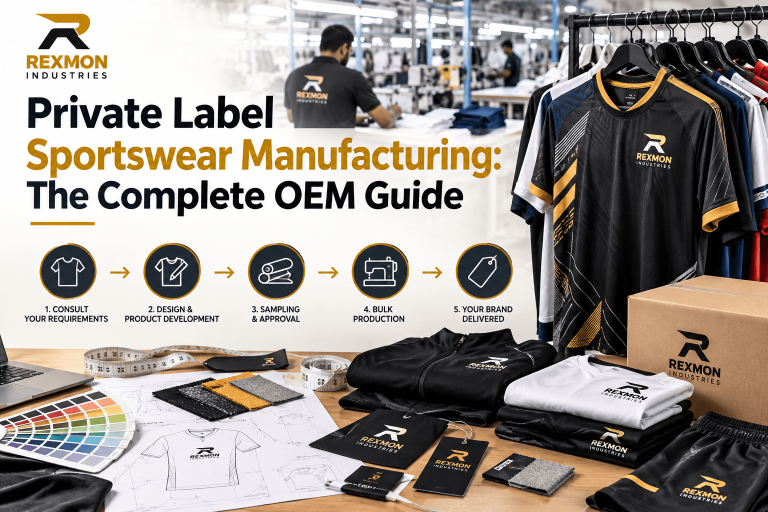
This is why a real manufacturer in Sialkot can make your kit, check it, pack it and ship it without handing the work to anyone else. The work stays under one roof, and the supply chain stays within reach of that roof. You can see what that looks like on our factory tour page, which walks through the six stages every order goes through: design preparation, sublimation printing and heat pressing, precision cutting, assembly, hand checking piece by piece, and packing, labelling and shipping.
Skilled Hands, Not Just Machines
Machines matter in a factory, but they are only half the story. The other half is the people who run them. A soccer kit is not stamped out by a press; it is cut, sewn, checked and packed by skilled hands, and the difference between a good kit and a poor one is usually the hands, not the machines.
Sialkot’s workforce is the reason the city holds its position. The people who cut the panels, sew the seams and check the finished pieces have spent their working lives in sports goods. They know how a jersey should sit on a shoulder, how a seam should flex when a player stretches, and what a print fault looks like before it reaches the packing bench. That judgement cannot be bought with a new machine. It comes from years of doing the same work, for the same kind of customer, in the same city.
It also explains why hand checking matters. Every piece we make is checked by hand before it is packed — print accuracy, stitching, sizing and finish — and anything short of the standard is remade, not shipped. A workforce that knows what to look for catches what a machine misses. That is how a factory keeps a 4.9 out of 5 rating from more than 500 clients worldwide, and how 98% of orders are dispatched on time.
Why Where Your Kit Is Made Should Matter to You
For a club, the city on the label is not a curiosity. It decides three things: whether the kit will be right, whether it will arrive on time, and whether the factory will still be there when you reorder next season.
Whether the kit will be right. A factory in a city that has made sports goods for generations has the patterns, the fabrics and the print experience to make a kit that fits and lasts. The six performance fabrics we stock — Interlock, Micro Mesh, Bird Eye Mesh, Pique, Tricot and Spandex, and Brushed Fleece — are chosen because they have been proven on real pitches, in real climates, by real players. The full range, with weights and best uses, is on our soccer jersey fabrics page.
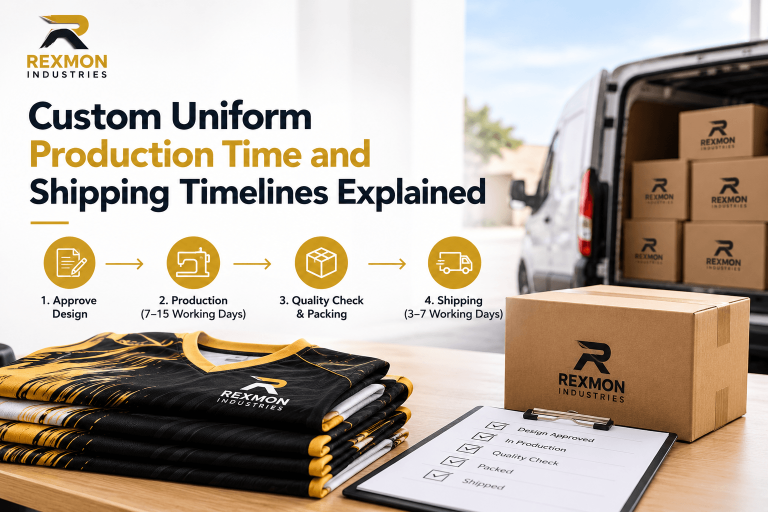
Whether it will arrive on time. A local supply chain and a workforce that knows the work means the schedule holds. Our production runs 7 to 15 working days after you approve the design, and orders ship with tracking worldwide. Free shipping in the United States applies on orders over 10 uniforms. When a league start or a tournament does not move, the kit has to be ready, and a factory that controls its own supply chain is the one that can promise that.
Whether the factory will still be there next season. Clubs reorder. A player moves up an age group, a new squad joins the academy, a kit wears out. When the design and the colour files stay on record with the factory, the reorder is printed from the same files, and the colours match the first order exactly. That only works if the factory is still making kit next season — and a factory in the centre of the world’s soccer kit industry is not going anywhere.
Rexmon Industries in Sialkot
Rexmon Industries manufactures custom soccer uniforms in its own facility in Sialkot, Pakistan, and has done so since 2018. There is no trading company and no agent between your order and the people who make it, and there is no minimum order: one piece or a full club, the process is the same.
Our facility produces more than 50,000 pieces a month and ships to more than 20 countries. Every order starts with a free mockup delivered within 24 hours, with unlimited revisions until you approve it. Sizes run from Youth XS through Adult 5XL on one design, with mens, womens and youth cuts, and every piece is checked by hand before it is packed.
If you want the full picture of how a direct manufacturer in Sialkot works — what to check before you choose one, and what export paperwork your order needs — our soccer uniform manufacturers in Pakistan page covers it in detail, including a vetting checklist and the documents that travel with every order. The soccer uniform manufacturer page explains our capacity, our machines and our process in detail.
Get Your Kit Made in Sialkot
The reason most of the world’s soccer kit comes from Sialkot is simple: the city has the history, the supply chain and the skilled hands, all in one place. A club that orders from there is not taking a chance on a distant factory. It is ordering from the place that makes the game.
Tell us your colours, your design and your sizes, and we will price your kit and send your free mockup within 24 hours. There is no minimum order and no obligation. Get a quote