How to Find a Soccer Wear Manufacturer You Can Trust
Finding a soccer wear manufacturer is easy. Finding one you can trust with your club’s kit, your brand’s name or your customers’ orders is the hard part. A good-looking website and a low quote tell you almost nothing about what will actually arrive in the box. The manufacturers that fail you rarely fail on price. They fail on the things you never checked: a factory that does not exist, a sample that was never your design, a quality check that never happened, paperwork that was never included.
This post is a framework for evaluating a manufacturer, not a list of questions. If you want the questions themselves, our guide to the questions to ask your uniform supplier covers them in full. What follows is how to judge the answers you get, and how to test a manufacturer with a small order before you commit to a large one.
Start With the Factory, Not the Website
Every manufacturer has a website. Not every manufacturer has a factory. That is the first distinction to make, and it matters most, because everything else — capacity, quality, delivery — follows from it.
A real manufacturer makes your kit in its own facility: cutting, printing, sewing, checking and packing under one roof, by people it employs. A trading company buys finished kit from someone else’s factory and sells it on. Nothing on its website will say so, and the price may even look better, because a trader can shop around for the cheapest factory that week. What you lose is control: you cannot see the floor, and when something goes wrong, the person you are talking to is not the person who made the mistake.
How do you tell the difference? Ask to see the production floor. A manufacturer that owns its facility can show it to you — photos or video of the machines, the cutting tables, the print area, the packing benches. Look for a working factory, not a showroom: fabric on the tables, work in progress, machines in use. Stock photos tell you nothing. If a supplier cannot show you its own floor, or keeps putting it off, treat that as the answer.
Ask the same about the work itself: does the manufacturer print, cut and sew in house, or is any part sent out? A factory that does the whole job under one roof can fix a problem the same day it is found. One that outsources it cannot — the work is somewhere else, and so is the answer.
Rexmon Industries manufactures in its own facility in Sialkot, Pakistan, and has done so since 2018. You can see the production floor on our factory tour page, and the full picture of how a direct manufacturer works is on our soccer uniform manufacturer page.
How to Evaluate a Manufacturer
Once you know you are dealing with a real factory, evaluate it on seven points. Each one is something you can check in a single email exchange, and each one tells you something different about how the manufacturer works.
1. Own facility
The manufacturer owns and runs the factory where your kit is made. The proof is photos or video of its own production floor and machines, not stock images. A manufacturer that owns its facility can also walk you through the process, from design preparation to packing, because its own people do the work. A real factory describes clear stages without hesitating; a reseller describes them vaguely, because it has never walked the floor.
2. Capacity
Ask for a real monthly capacity number, in pieces per month — the same number every time you ask. It tells you two things: whether the factory can take your order at all, and whether your order will be pushed back when a bigger one arrives. A factory that will not give you a number, or whose number changes every time you ask, is guessing.
Our facility produces more than 50,000 pieces a month, so we can take on a whole league order, a multi-team academy or a brand launch without pushing smaller club orders to the back of the queue.
3. Physical samples
Never place a full order without approving a physical sample first — made to your specification, with your design, labels and sizes. It is the only proof a manufacturer can make what you asked for, and the only way to check what a photograph cannot show: fabric feel, print, seams and sizing.
Judge the process as much as the sample. A trustworthy manufacturer offers a physical sample before the bulk run, made to your specification. One that will not offer one, or sends a sample that is not your design, is running a sales exercise, not a production test. Nothing moves to production until you have approved the sample — fabric, fit and print.
4. Quality control
Quality control is a process you can ask about, and the answer tells you everything: what is checked, when, and what happens to pieces that fail.
A trustworthy manufacturer checks every piece by hand before packing — print, stitching, sizing, finish — and remakes anything that falls short rather than shipping it. Sample-only checks, one piece out of a hundred, are not quality control; they are a hope. A manufacturer that cannot describe what its quality check rejects has never really checked.
See exactly what we check on our quality control page: every piece is checked by hand, and anything short of the standard is remade, not shipped.
5. Export documentation
If your manufacturer is overseas, your order needs paperwork to cross a border: a commercial invoice, a packing list and, where your country needs one, a certificate of origin, with the HS code on the invoice and a bill of lading or airway bill from the carrier. A manufacturer that exports every week supplies these as part of the service, because the paperwork is routine.
Check two things: whether the documents are included in the price or charged as a surprise, and whether the manufacturer can supply a chamber-certified certificate of origin if your country needs one. A regular exporter will have straight answers to both. One that treats paperwork as an afterthought will have neither — and your shipment will sit at customs while you wait.
The full list of what an export order needs is on our page about soccer uniform manufacturers in Pakistan.
6. Communication
You are ordering from a factory you may never visit, so communication is the whole relationship. Judge it early — it will not get better after you have paid. A trustworthy manufacturer gives you a named contact, clear timelines in writing, and written confirmation of the design before anything is made.
Test it: send a clear email with a clear question. A reply that answers it, gives a timeline and confirms what happens next means a professional operation. A slow reply, or a different answer each time, is what you will get when your order is in production and you need an update.
7. Payment terms
Agree payment terms in writing before you commit. Everything upfront, with no sample stage and no written order confirmation, means you take all the risk. A trustworthy manufacturer ties payment to stages you can verify: a sample you approve, a production run you have seen a mockup for, and a shipment you can track.
Be wary of terms that change after you agree them, or costs that only appear at the end — shipping, paperwork, a charge for labels that were in the original quote. Get the full price in writing before you pay anything. If a manufacturer will not put the price and the terms in writing, that is the answer.
Red Flags That Should Stop You
Some warning signs are not worth debating. If you see any of these, stop and find another manufacturer.
No factory to show. Stock photos only, no photos or video of their own production floor. A real factory is proud of its floor; a reseller hides behind a website.
No sample, or a sample that is not your design. A sample made for someone else proves nothing, and a manufacturer that will not make one to your specification is not confident it can.
No capacity number. A manufacturer that cannot tell you how many pieces it makes a month cannot tell you when your order will be ready, either.
No paperwork offered. If export documentation is not mentioned, or is treated as a chargeable extra, your shipment will hit customs without the documents it needs.
Slow, vague replies. If communication is poor before you have paid, it will be worse after, when you need an update on your order.
Prices that move. A quote that changes every time you ask, or drops sharply when you hesitate, is not a price — it is a negotiation tactic, and the first price was never real.
No written confirmation. If a manufacturer will not confirm the design, quantities, sizes, price and timeline in writing before production starts, you have no record of what you agreed — and no way to hold anyone to it.
One red flag on its own might have an innocent explanation. Two or three together is a pattern, and a pattern is a decision. Move on.
Run a Trial Order Before You Commit
The most reliable way to test a manufacturer is a small trial order. Not a sample — a real order, small enough to risk, large enough to test the whole process. One squad, one design, one delivery. A trial order tests everything the framework above only describes: the communication, the mockup, the production time, the quality check, the packing and the shipping.
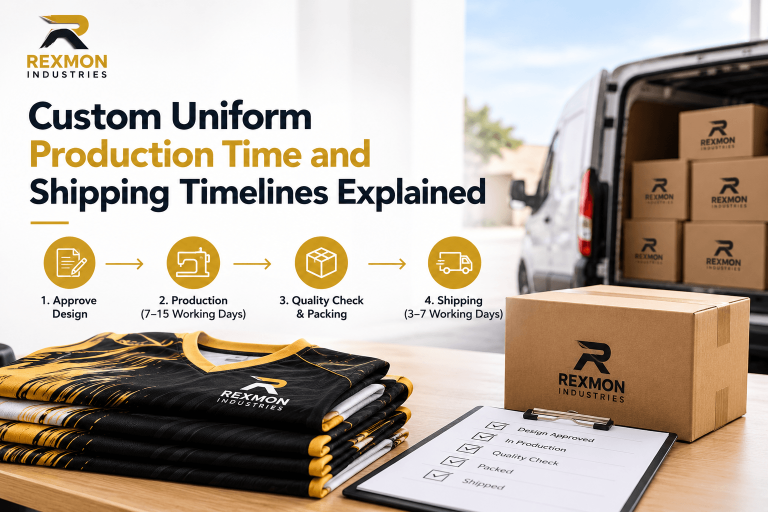
Run the trial exactly as you would run the full order. Send your design, sizes and quantities through the quote form, and approve the free mockup — it arrives within 24 hours, with unlimited revisions until it is right. Then watch: did production take 7 to 15 working days after approval, as quoted? Did every piece arrive checked, sorted and bagged by player, with colours matching the mockup and numbers in the same place on every shirt?
A trial order also tests how the manufacturer handles problems. Something small will almost always go wrong on a first order — a size query, a colour question, a delivery date to confirm. What matters is whether it tells you early, explains the options, and fixes it without being chased. One that handles a small problem well on a trial order is one you can trust with a large one. One that hides a problem will hide a bigger one later.
If the trial goes well, the full order is straightforward, because your design and colours are already on file. Your next order is printed from the same files as your last one, so the colours match and the numbers sit in the same place. That is how a long-term relationship starts — not with a promise, but with a small order that arrived as quoted.
What a Trustworthy Manufacturer Looks Like in Practice
A trustworthy manufacturer is not a mystery. It looks like this: an own facility you can see, a capacity number stated in writing, a physical sample made to your specification before the bulk run, every piece checked by hand with rejects remade, export documentation as standard, a named contact who replies promptly, and payment terms agreed in writing before you commit.
That is how we work at Rexmon Industries. We have manufactured custom soccer uniforms in our own facility in Sialkot, Pakistan, since 2018: more than 50,000 pieces a month, shipped to more than 20 countries, with 98% of orders dispatched on time. Every order starts with a free mockup within 24 hours, production takes 7 to 15 working days after approval, and every piece is checked by hand before it is packed. Our client rating is 4.9 out of 5, from more than 500 clients worldwide.
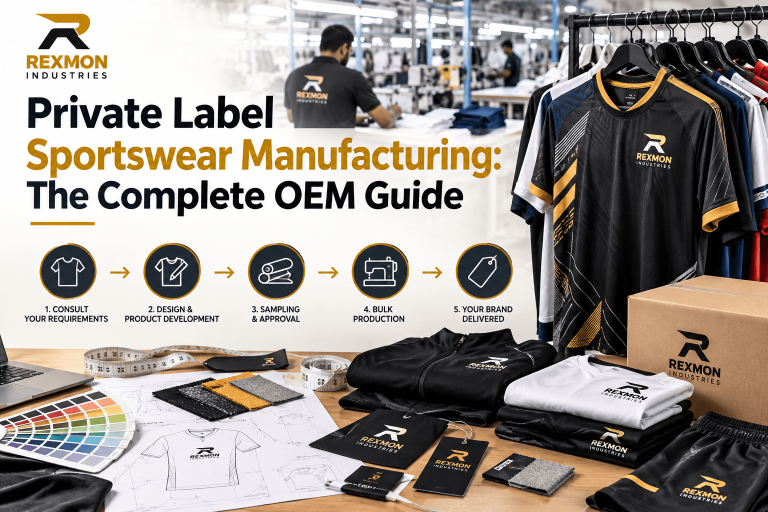
The same standard applies to brands. Our OEM and private label service covers woven and printed neck labels, size tags, care labels and neck and sleeve branding, with orders packed retail ready — poly bags, hang tags, barcodes and branded boxes — and a sampling service so you can approve a physical sample before the bulk run.
Your Evaluation Checklist
Use this checklist on any manufacturer you are considering. Every item is a check you can make in one email, and a trustworthy manufacturer will answer all of them clearly.
| What to check | What good looks like | Warning sign |
|---|---|---|
| Own facility | Photos or video of their own production floor and machines | Stock photos, or no photos of the factory at all |
| Direct manufacturing | They print, cut, sew, check and pack in house | They buy finished kit and resell it |
| Monthly capacity | A real capacity number, in pieces per month | No number, or one that changes every time you ask |
| Physical sample | A sample made to your specification, with your labels | No sample offered, or a sample that is not your design |
| Quality control | Every piece checked by hand before packing, with rejects remade | Sample-only checks, or no process described |
| Export documentation | Invoice, packing list and certificate of origin as standard | No paperwork offered, or paperwork charged as an extra surprise |
| Communication | A named contact, clear timelines, written approval | Slow replies, no written confirmation of the design |
| Payment terms | Agreed in writing before you commit, tied to stages you can verify | Everything upfront, or terms that change after you agree them |
| Shipping | Tracked worldwide shipping, free U.S. shipping on larger orders | No tracking, or shipping cost only revealed at the end |
Work through the list and the difference shows quickly: a manufacturer that owns its facility can show you the floor, one that checks every piece can tell you what it rejects, and one that exports every week has the paperwork ready.
Where to Start
Ready to test a manufacturer? Start with a trial order. Tell us your colours, design and sizes, and we will price your order and send your free mockup within 24 hours. There is no minimum order, so a single squad is a proper test — one piece or a full club, same process, same free mockup, same hand checking. Get a quote
For the questions to ask alongside this framework, our guide to the questions to ask your uniform supplier covers them in full. And if you are comparing manufacturers in Pakistan, our page on soccer uniform manufacturers in Pakistan explains the export documentation and the vetting checklist for that market.